



What Are Data Pillars?
Data pillars are key themes that assist set up and ship info inside a studying system or group. They function a framework that ties collectively content material, studying experiences, and efficiency objectives right into a unified information construction.
Why are they essential, although? Fashionable L&D has moved from merely creating content material to fascinated with whole programs. As a substitute of constructing separate programs, organizations now create linked studying networks. Data pillars assist with this alteration by organizing content material clearly. This makes it simpler to know, bear in mind, and apply expertise rapidly. These additionally align with the pillars of data administration, guaranteeing that studying will not be solely created but in addition saved, shared, and used successfully.
Nonetheless, information pillars are to not be confused with subjects or expertise. They’re the principle areas that form a curriculum or studying plan, beneath which you discover particular subjects which can be targeted items of content material. Now, expertise are what learners are anticipated to do with that information. Collectively, information pillars, subjects, and expertise create a system that connects studying with its real-world utility.
Desk Of Contents
Data Pillars In Tutorial Design
Conventional programs typically have a straight path: one module follows one other, with little connection between them. However trendy Tutorial Design is altering this. Now, they give attention to information pillars, which assist join totally different subjects. This implies studying is not only a sequence of remoted details; as an alternative, every part works collectively to assist an even bigger image.
For Studying Expertise Designers (LXDs) and curriculum designers, this strategy is essential. Data pillars assist set up content material round key subjects, making studying clearer and simpler to scale. In addition they match nicely with the pillars of data administration, guaranteeing that studying is structured for long-term use and easy accessibility. Let’s examine intimately how Tutorial Designers use information pillars.
How Tutorial Designers Use Data Pillars
Tutorial Designers use information pillars to carry readability and consistency to advanced studying environments. As a substitute of designing standalone programs, they construction whole academies or packages round an outlined set of pillars.
These pillars information:
- Course construction, guaranteeing all content material suits inside a transparent framework.
- Studying paths, serving to learners progress logically throughout subjects.
- Content material reuse, enabling scalable ecosystems moderately than one-off supplies.
When aligned with the 4 pillars of data administration, this strategy ensures that information will not be solely created but in addition saved, shared, and utilized successfully.
For instance, in a management growth program, the curriculum focuses on 4 pillars: communication, decision-making, emotional intelligence, and strategic considering. Each contains a wide range of studying supplies, follow actions, and assessments. Learners can transfer between these pillars based mostly on their roles and desires, moderately than following a set order. This strategy creates a versatile studying expertise whereas nonetheless offering a robust construction. It reveals how these key areas assist each this system’s design and the group’s general studying technique.
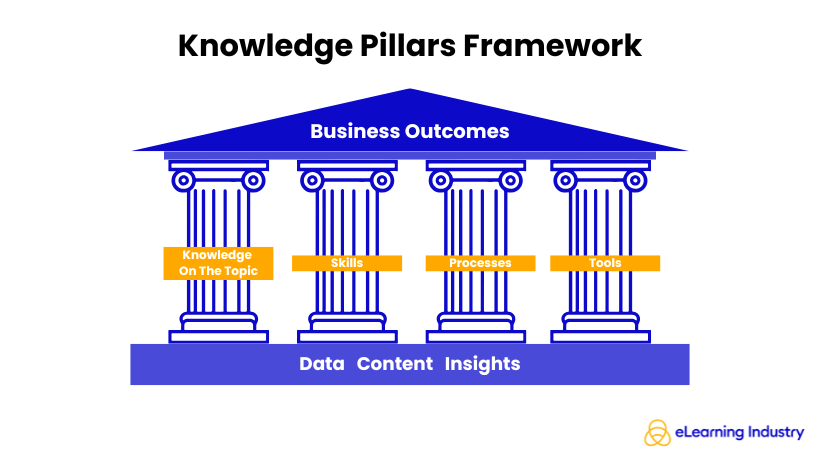
Data Pillars Vs. Studying Goals
Data pillars and studying aims play totally different roles in Tutorial Design. Data pillars are the principle subjects that set up content material all through a curriculum or studying system. They supply a framework that helps Tutorial Designers create efficient studying environments. However, studying aims are clear statements about what learners ought to know or have the ability to do after a particular studying expertise.
Data pillars give attention to the large image, whereas studying aims give attention to particular outcomes. For instance, a pillar like “Knowledge Literacy” might embrace a number of programs, every with its personal measurable aims. Understanding this distinction is essential when designing programs that assist broader information administration objectives.
Data Pillars | Studying Goals |
| Structural | Final result-driven |
| Lengthy-term | Session-level |
| Organizing precept | Measurement device |
When information pillars and studying objectives are blended up, the design of studying can turn out to be unclear.
- First, this could result in a mismatch between the construction and the outcomes. With out clear pillars, the educational objectives may not connect with a broader studying technique.
- Second, it typically ends in duplicated content material. Groups would possibly create related modules for various objectives as a result of there isn’t a shared framework.
- Lastly, learners wrestle to navigate the fabric. They wrestle to know how particular person programs match into a bigger system, which might decrease engagement and cut back information retention.
These issues typically spotlight gaps in making use of the 4 pillars of data administration, particularly in how information is organized and shared.
Thus, information pillars and studying aims are best when used collectively. Pillars outline what issues at an organizational stage, guiding how information is grouped and prioritized. Goals, however, outline what success appears like on the learner stage by setting clear expectations and measurable outcomes.
The 4 Pillars Of Data Administration
The 4 pillars of data administration supply a transparent, broadly accepted framework for organizations to handle information from creation to make use of. This mannequin sees studying content material as a part of a system moderately than as separate objects. It encourages steady era, storage, sharing, and utility of data. For Tutorial Designers, these pillars present a useful basis for creating studying programs that may develop. When these pillars information the design course of, they assist flip disconnected content material into efficient and cohesive studying environments.
1. Data Creation
Data creation is the place to begin of any efficient information administration framework. It includes producing new insights from Topic Matter Consultants (SMEs), organizational knowledge, and real-world expertise.
In L&D environments, this typically contains:
- Capturing experience from inside leaders.
- Translating tacit information into structured studying content material.
- Utilizing efficiency knowledge to establish rising ability wants.
Tutorial Designers play a important function right here. They don’t simply doc information however form it into significant studying experiences. And not using a robust creation course of, even the best-designed information pillars will lack depth and relevance.
2. Data Storage
As soon as information is created, it must be organized and saved so it’s accessible and usable. That is the place programs like LMS platforms, LXPs, and information bases come into play.
Efficient storage means:
- Structuring content material into clear classes and domains.
- Aligning supplies with outlined information pillars.
- Making certain content material is searchable and simple to replace.
Poor storage results in duplication, outdated content material, and low engagement. For Tutorial Designers, this pillar is crucial to sustaining a scalable curriculum design framework that helps long-term progress.
3. Data Sharing
Data solely creates worth when it strikes throughout the group. Data sharing focuses on distributing insights by way of formal and casual channels.
This contains:
- Social studying environments
- Peer-to-peer collaboration
- Communities of follow
Fashionable studying programs rely closely on this pillar. As a substitute of top-down supply, information flows by way of networks. When aligned with information pillars, sharing turns into extra intentional, guaranteeing that the fitting info reaches the fitting viewers on the proper time.
4. Data Software
The ultimate, and most important, pillar is information utility. That is the place studying interprets into motion and measurable efficiency outcomes.
Software occurs when:
- Workers use information in actual work eventualities.
- Studying is embedded into every day workflows.
- Efficiency improves on account of studying interventions.
For Tutorial Designers, this pillar shifts the main target from content material supply to influence. It ensures that studying is not only consumed however actively used, reinforcing the worth of each the information administration framework and the underlying information pillars.
Aligning Data Administration Pillars With Studying Design
The true worth of the pillars of data administration emerges when they’re built-in into studying design. Collectively, they create a bridge between information administration and L&D technique.
- Data creation informs content material growth.
- Data storage helps a structured studying structure.
- Data sharing enhances engagement and collaboration.
- Data utility drives efficiency and enterprise outcomes.
For mid- to senior-level Tutorial Designers, this alignment is important. It permits the transition from course design to system design, the place studying is not only delivered however constantly evolving. By combining the 4 pillars of data administration with well-defined information pillars, organizations can construct scalable, measurable, and aligned studying ecosystems.
How To Construct Data Pillars For A Curriculum
Designing efficient information pillars will not be about organizing content material, however about structuring how folks study, apply, and retain information over time. For Tutorial Designers, this course of combines curriculum design, enterprise technique, and efficiency outcomes. When completed accurately, information pillars present the inspiration for a scalable studying system.
Step 1: Establish Core Data Matters
Begin by defining the core subjects that matter most to your group. These will turn out to be your information pillars.
This step must be grounded in three inputs:
- Enterprise objectives: What capabilities does the group must develop or remodel?
- Talent gaps: The place are learners at present underperforming?
- Position necessities: What information is crucial for fulfillment in particular roles?
For instance, in a gross sales group, your pillars would possibly embrace product information, negotiation, buyer psychology, and pipeline administration. These usually are not random; they replicate important efficiency areas. Sturdy pillars of data administration at all times tie again to enterprise relevance, not simply content material availability.
Step 2: Cluster Associated Matters
As soon as your subjects are outlined, the subsequent step is to group associated subjects beneath every pillar. That is the place construction begins to take form.
Search for patterns. What subjects naturally belong collectively? What overlaps or repeated concepts exist? This course of helps create readability. For instance, beneath a “Communication” pillar, you would possibly cluster subjects like lively listening, suggestions supply, and battle decision. This strategy transforms scattered content material right into a cohesive information administration framework.
For this step, fastidiously evaluation your present content material and ask for SME enter to validate your selections.
Step 3: Align With Competencies And Outcomes
Data pillars alone usually are not sufficient; they need to connect with measurable efficiency.
Every pillar ought to map to:
- Particular competencies
- Clear studying outcomes
- On-the-job behaviors
This ensures that your curriculum is not only informative, however actionable. It additionally bridges the hole between studying design and enterprise influence. At this stage, consider your pillars as enablers of functionality. Within the context of the 4 pillars of data administration, that is the place information strikes from storage to utility.
Step 4: Design Studying Pathways Round Pillars
Along with your construction in place, now you can design studying pathways.
This includes:
- Sequencing content material from foundational to superior.
- Scaffolding studying to construct depth over time.
As a substitute of remoted programs, you create guided journeys inside every pillar. For instance, a learner would possibly begin with primary ideas, progress to utilized eventualities, and finally attain mastery-level follow.
This strategy helps personalization and makes your information pillars simpler to navigate. It additionally displays how trendy learners interact with content material, which is non-linear, contextual, and goal-oriented.
Step 5: Validate And Iterate
No studying structure is full with out validation. Use:
- Learner engagement knowledge
- Evaluation outcomes
- Suggestions from stakeholders
Are learners progressing as anticipated? Are the pillars clear and helpful? The place are drop-offs occurring? Steady iteration ensures that your pillars of data administration stay related as enterprise wants evolve. Over time, this creates a dynamic system moderately than a static curriculum.
Frequent Errors When Defining Data Pillars
Even skilled groups wrestle when defining information pillars. The problem isn’t effort; it’s construction. Poorly designed pillars weaken each studying design and broader information programs.
Creating Too Many Pillars
When groups break content material into too many classes, the construction turns into arduous to navigate. Learners can not see how subjects join, and Tutorial Designers lose the power to construct clear studying pathways. Sturdy information pillars ought to simplify complexity, not multiply it.
Making Them Too Broad
On the different excessive, overly broad pillars turn out to be meaningless. For instance, a pillar like “Management” and not using a sub-structure doesn’t information design choices. Efficient pillars want sufficient specificity to assist curriculum design whereas nonetheless functioning as steady subjects inside a information administration framework.
Ignoring Enterprise Alignment
Data pillars should replicate the group’s actual priorities. When they’re outlined in isolation from enterprise objectives, they fail to assist efficiency. That is the place alignment with the pillars of data administration turns into important. If information will not be created, shared, and utilized in ways in which drive outcomes, the construction provides little worth.
Treating Them As Static
Many organizations outline pillars as soon as and by no means revisit them. Nonetheless, information evolves. Abilities shift. Markets change. The 4 pillars of data administration spotlight the significance of steady information creation and utility, so your construction ought to evolve accordingly.
How Data Pillars Enhance Studying Outcomes
Data Retention
By clearly defining the core themes of a curriculum, Tutorial Designers and studying architects can construction content material to assist higher retention. When info is organized round information pillars, learners can chunk associated ideas, lowering cognitive overload and making it simpler to recall important info.
Quicker Onboarding
When new staff or learners enter a company, having content material structured by information pillars permits them to rapidly perceive important domains with out being overwhelmed by fragmented or irrelevant supplies. This improves ramp-up time and ensures that studying is instantly actionable.
Improved Data Switch
By connecting studying modules to core pillars, learners can see how expertise and data apply throughout contexts, selling sensible utility and long-term retention.
Alignment With Enterprise Targets
Lastly, information pillars strengthen alignment with KPIs and enterprise aims. When studying packages are constructed round strategic information subjects, it turns into simpler to measure outcomes, consider influence, and make sure that coaching contributes on to organizational objectives.
Conclusion
By clearly defining and organizing key information areas, organizations can enhance studying effectivity, cut back duplication, and assist constant ability growth inside groups. For Studying and Growth leaders, Tutorial Designers, and studying architects, these information pillars type the inspiration of curriculum design and studying technique, connecting the content material to clear, measurable objectives. Trying forward, organizations that deliberately construction, handle, and leverage information will acquire a aggressive benefit, driving efficiency, agility, and long-term workforce success.
Regularly Requested Questions (FAQ) About Data Pillars
The 4 pillars of data administration are Data Creation, Data Storage, Data Sharing, and Data Software. These pillars present a structured strategy to capturing, organizing, and utilizing organizational information, guaranteeing that studying and insights are accessible, actionable, and aligned with enterprise objectives.
Data pillars are core thematic areas that construction info inside a studying system or group. They act as guiding rules for curriculum design, studying paths, and information administration, serving to Tutorial Designers and L&D leaders set up content material, cut back redundancy, and enhance retention.
Data pillars assist scale studying packages, align content material with enterprise aims, and improve information retention. By making a structured studying structure, they make it simpler for workers to entry related info and for leaders to measure studying influence.
Data pillars outline the broad construction of what learners must know, whereas studying aims describe particular, measurable outcomes inside every pillar. Collectively, they guarantee coherent curriculum design and efficient studying measurement.
Efficient information pillars begin with figuring out core information domains, clustering associated subjects, aligning with competencies, and designing studying pathways. They need to be validated with learner suggestions and up to date to replicate evolving organizational wants.
Sure. Data pillars present a structured framework for AI programs to map content material, advocate studying paths, and generate dynamic studying experiences. They assist AI instruments set up info semantically, enhancing personalization and information accessibility at scale.


