



Why Asking AI Questions Is A Core Ability In Trendy L&D
To ask AI questions is now not a easy activity, however a core ability for contemporary L&D professionals. The transfer from conventional search engines like google to AI instruments that reply questions immediately has modified how folks entry, consider, and use information at work. In consequence, as an alternative of wanting by many sources, professionals now depend on AI to shortly collect insights.
This makes asking AI questions a strategic ability, not only a technical one. The solutions you get rely lots on the way you ask the questions. Utilizing clear and arranged prompts helps AI present related, detailed, and correct solutions. For Educational Designers, this implies specializing in find out how to body questions quite than simply occupied with the solutions.
We are able to already see the advantages in L&D workflows. When groups use AI nicely, they create content material sooner, shifting from an thought to a draft in a lot much less time. Additionally they make higher selections through the use of AI to check totally different strategies, summarize analysis, and discover choices. On this new setting, those that ask higher questions are extra profitable at designing studying experiences, testing concepts, and growing their impression.
In This Information…
What Occurs When You Ask AI A Query?
Once you ask AI questions, you are not looking a database; you are utilizing a system that predicts the very best response primarily based on patterns in information. These programs take your enter, perceive what you imply, and create responses that sound human-like. Nevertheless, they do not “know” details within the typical sense; they generate potentialities.
This is the reason solutions can differ. In case you ask obscure AI questions, the system makes assumptions. This typically ends in solutions that sound good however lack element or accuracy. Generally, AI could give assured however mistaken solutions as a result of it focuses on sounding coherent quite than being right.
There is a vital distinction between asking a easy query and utilizing a structured immediate. A fundamental query like “Are you able to clarify onboarding?” yields broad, generic solutions. In distinction, a structured immediate that provides context, viewers, and format helps the AI present extra correct and helpful responses. For L&D professionals, this distinction is essential. The standard of AI solutions relies on the way you body your query, not simply the AI instrument you employ.
How To Ask AI Questions Successfully
To ask AI questions successfully, deal with the way you construction your prompts. The distinction between common and high-value AI questions and solutions typically comes right down to construction. When you’ve got ever puzzled, “How do I ask AI a query in a approach that delivers usable outcomes?”, a easy framework could make that course of simpler.
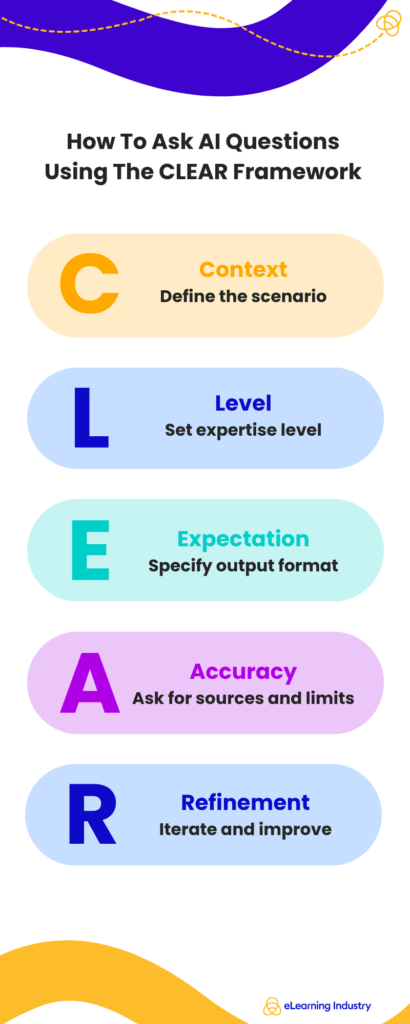
One such framework is the CLEAR framework. It’s designed to assist professionals get constant, high-quality outputs when working with any AI to reply questions. Let’s break it down.
C—Context: Outline The Situation
AI performs greatest when it understands the state of affairs. As an alternative of asking broad or generic AI questions, present background.
- What’s the enterprise purpose?
- Who’s the viewers?
- What constraints exist?
Instance:
As an alternative of: “Create coaching content material.”
Ask: “Create onboarding coaching for distant gross sales groups in a SaaS firm with a deal with product adoption.”
Including context improves how AI solutions questions by narrowing the scope and aligning the response with real-world wants.
L—Degree: Specify Experience Degree
Probably the most neglected features of find out how to ask an AI assistant questions is defining the extent of complexity.
- Newbie (new hires, fundamental understanding)
- Intermediate (working professionals)
- Superior (leaders, specialists)
Instance:
“Clarify this as if I’m a senior L&D chief designing an enterprise studying technique.”
This ensures the output matches the required information degree, making AI questions and solutions extra actionable.
E—Expectation: Outline Output Format
AI can ship data in a number of codecs. If you don’t specify, you danger receiving unstructured responses.
- Listing
- Framework
- Desk
- Step-by-step information
Instance:
“Present a 5-step framework in bullet factors.”
This step is essential in find out how to ask AI a query, particularly when outputs are utilized in studies, studying supplies, or stakeholder shows.
A—Accuracy: Ask For Sources, Constraints, Or Assumptions
AI doesn’t at all times make clear its reasoning. To enhance reliability when utilizing AI to reply questions, explicitly request validation.
- Ask for assumptions.
- Request limitations.
- Embrace source-based reasoning when wanted.
Instance:
“Embrace assumptions and be aware any limitations in your reply.”
This strategy strengthens belief in AI solutions, notably for strategic selections in L&D.
R—Refinement: Iterate With Comply with-Up Prompts
The primary response is never the ultimate one. Robust customers of AI deal with it as a dialog.
- Make clear unclear factors.
- Ask for enlargement or simplification.
- Request various views.
Instance:
“Refine this for a worldwide viewers” or “Make this extra concise.”
Refinement is what distinguishes fundamental utilization from superior question-answering AI practices.
Examples Of Excessive-High quality AI Questions
Once you ask AI questions, the standard of the solutions relies on how clearly you phrase your prompts. Many professionals assume that AI will mechanically perceive what they imply, however obscure questions result in generic solutions. Then again, well-structured questions unlock extra helpful insights. In the end, studying to refine your questions for AI is what makes the distinction between fundamental use and producing high-impact outcomes.
Weak Vs. Robust AI Prompts
A standard mistake groups make when asking AI questions is being too obscure.
Instance #1
Weak: “Clarify onboarding.”
Robust: “Create a 30-day onboarding framework for distant gross sales staff in a SaaS firm, together with milestones and measurable outcomes.”
The distinction is readability. Robust prompts embody context, viewers, and anticipated output. This enables AI to generate extra related and actionable insights.
Instance #2
Weak: “Give me coaching concepts.”
Robust: “Counsel 5 microlearning modules to enhance management communication expertise for mid-level managers, together with studying targets.”
One of the best AI questions should not essentially longer, however extra exact. Once you constantly enhance the way you ask AI questions, you progress from surface-level solutions to structured, usable outputs.
Use Circumstances For L&D Professionals
For Educational Designers and L&D leaders, realizing the correct inquiries to ask AI can considerably enhance effectivity and high quality throughout workflows.
Designing Programs
As an alternative of asking, “Assist me design a course,” attempt: “Define a blended studying program on compliance coaching for a worldwide workforce, together with digital and instructor-led elements.”
Creating Assessments
Quite than: “Create quiz questions,” ask: “Generate 10 scenario-based evaluation questions to judge decision-making in customer support roles.”
Producing Eventualities
Weak prompts typically miss realism. A stronger strategy: “Create a office battle situation for management coaching, together with character roles and resolution factors.”
Analysis
As an alternative of: “Summarize this subject,” ask: “Summarize key traits in AI-driven studying personalization, highlighting implications for enterprise L&D technique.”
These examples present that efficient prompting is much less concerning the instrument and extra about the way you assume. The extra intentional you’re while you ask a query, the extra strategic and dependable your outputs turn into. Over time, creating this ability results in higher content material, sooner workflows, and stronger studying experiences.
Finest AI Instruments For Answering Questions
One of the best AI instruments for answering questions come from a variety of capabilities that assist with totally different phases of considering, analysis, and decision-making. For Educational Designers and L&D professionals, deciding on the correct AI relies on the precise activity: ideation, validation, or enterprise execution.
At a excessive degree, there are three essential classes to know.
Normal AI Assistants
These instruments are constructed for pace and flexibility. They supply fast solutions, assist draft content material, and assist you to discover concepts. They’re helpful for a lot of AI-related questions and may help with early educational design duties, akin to outlining modules and brainstorming studying targets.
Analysis-Targeted AI Instruments
These instruments are designed for in-depth understanding and validation. They work greatest for advanced questions the place accuracy and sources are essential. If you find yourself specializing in compliance coaching, management growth, or data-driven studying methods, these instruments enhance AI responses by offering clear insights quite than simply easy solutions.
Enterprise AI Copilots
These instruments match into the programs and workflows of organizations. They allow safe and related interactions utilizing inner information. For L&D groups, this implies they’ll ask AI questions on inner insurance policies, studying information, or efficiency information. This helps them make higher selections shortly.
What Makes The Finest AI Query Answering System?
Not all instruments carry out equally. One of the best AI query answering programs share just a few essential traits.
- Accuracy is foundational. Robust programs cut back hallucinations and supply dependable outputs, particularly when answering advanced or high-stakes questions.
- Context retention is what separates fundamental instruments from superior ones. Which means recalling prior inputs permits professionals to refine their strategy when asking AI questions, resulting in extra significant, tailor-made outcomes.
- Supply transparency is important for belief. One of the best instruments present how solutions are fashioned, enabling L&D professionals to validate data earlier than utilizing it in studying content material or technique.
- Customization permits customers to form how the AI responds. Whether or not defining tone, format, or viewers degree, customization ensures that the AI aligns with particular educational objectives.
Free Vs. Paid Instruments To Ask AI Questions: What Professionals Ought to Know
To ask AI questions nicely, professionals have to know the variations between free and paid instruments. Free platforms make it straightforward to ask questions, however the worth you obtain relies on your objectives, context, and the way advanced your questions are.
Free AI Instruments
Professionals
- Pace and accessibility
- Fast solutions
- Fundamental analysis
- Early-stage ideation
For instance, if you’re exploring course matters, drafting outlines, or testing concepts, utilizing an AI can ask inquiries to speed up your workflow with out including value. In these circumstances, the flexibility to ask AI any query and get an immediate response is commonly sufficient to maneuver ahead.
Cons
- Lack of depth
- Inconsistency
- No contextual consciousness
Finest for: Low-risk, exploratory duties, akin to brainstorming, content material drafting, or producing examples.
Paid AI Instruments
Professionals
- Higher context retention
- Improved output high quality
- Stronger information privateness
- Integrations with enterprise programs akin to LMS platforms.
Cons
- Monetary prices
- Efficiency uncertainty
- Over-reliance and ability loss
- Privateness considerations
Finest for: Complicated studying experiences, in-depth evaluation, or stakeholder-facing deliverables.
Frequent Errors When Asking AI Questions
Asking AI questions successfully is not only about typing a immediate, however about how clearly you assume. Many professionals begin asking AI questions with out realizing that small errors can result in weak or deceptive outputs.
Obscure Questions
When customers write broad prompts like “clarify onboarding” or “create coaching,” the AI lacks adequate path. Robust questions AI can reply nicely are at all times particular, structured, and tied to a transparent purpose.
Ignoring Context
AI performs greatest when it understands the state of affairs. When you’ve got requested AI to generate studying content material however don’t point out the viewers, trade, or format, the response will possible really feel generic. Context is what turns a fundamental output into one thing usable for L&D technique.
Treating AI As A Search Engine
In contrast to conventional search, AI doesn’t retrieve a listing of sources, however generates responses. Which means asking AI questions requires extra precision and intention than typing key phrases into Google.
Not Validating Outputs
Even when AI gives assured solutions, they aren’t at all times correct. Relying blindly on questions AI generates or responds to can result in flawed selections. Reviewing, cross-checking, and refining outputs is important, particularly in skilled environments.
How Asking Higher AI Questions Improves Studying Design Outcomes
Once you ask AI questions successfully, the impression on studying design turns into instantly measurable. For Educational Designers and L&D professionals, the flexibility to construction AI questions is not only a productiveness increase; it immediately influences the standard, relevance, and scalability of studying experiences.
Quicker Content material Growth
Once you clearly outline context, viewers, and anticipated output, AI instruments can generate structured drafts, studying targets, and assessments in seconds. As an alternative of revising generic outputs, you begin nearer to a usable end result, considerably decreasing growth cycles.
Deeper Personalization
By specifying learner profiles, ability ranges, and enterprise objectives, you information the system towards tailor-made responses. This permits AI to reply questions extra aligned with actual learner wants, supporting adaptive and role-based studying paths.
Improved Scalability
Once you refine find out how to ask AI a query, you possibly can reuse high-performing prompts throughout a number of packages, groups, or areas. This transforms query answering AI right into a repeatable system quite than a one-off instrument, permitting L&D groups to scale content material with out sacrificing high quality.
Higher Choice-Making
Leaders who ask AI questions clearly can extract insights, evaluate methods, and consider studying interventions extra successfully. As an alternative of obscure outputs, they obtain structured, actionable data that helps enterprise alignment.
Conclusion
Asking inquiries to AI is a helpful ability that may enhance your considering. For L&D professionals and Educational Designers, the way you ask a query impacts the solutions you get. As an alternative of viewing AI as a fast repair, see it as a companion for exploring concepts and fixing issues. Strive totally different prompts, refine them as wanted, and evaluate the AI’s solutions with your individual information. The clearer and extra particular your questions are, the higher the solutions you’ll obtain. By mastering this ability, you may make higher selections, pace up content material creation, and improve your studying methods.
Incessantly Requested Questions (FAQ) About Asking AI
Begin with a transparent context, outline the kind of reply you want, and refine iteratively. Specify format, scope, or examples to get exact insights.
Use particular, goal-oriented prompts. Keep away from obscure queries. Break advanced questions into smaller elements for readability.
Some AI instruments, like ChatGPT, assist you to add visuals and ask associated questions. Examine platform capabilities and file codecs.
Sure. Many instruments, together with ChatGPT Free and different AI assistants, permit free queries however could have limitations in depth, pace, or superior options.
It relies on the use case. ChatGPT excels in conversational and structured responses, whereas Ask AI could supply totally different options or specialised integrations. Consider primarily based on accuracy, context dealing with, and workflow match.
Widespread free choices embody ChatGPT Free, Gemini, and Perplexity AI. Enterprise variations typically supply superior capabilities and fewer restrictions.
Sure. You may ask ChatGPT any query inside its information base, utilizing exact prompts for higher, actionable responses.


