


What Is Bloom’s Revised Taxonomy?
Bloom’s revised taxonomy is a information for classifying studying objectives primarily based on how advanced they’re. It helps academics and Educational Designers manage studying from easy recall of info to higher-order pondering abilities. In contrast to the unique mannequin, Bloom’s revised taxonomy emphasizes energetic studying as an alternative of simply itemizing static data.
The framework was first launched by Benjamin Bloom in 1956, the place it primarily organized studying into knowledge-based classes. Nonetheless, in 2001, the taxonomy was revised by Anderson and Krathwohl to higher replicate fashionable studying wants. This up to date model modified the construction and emphasis, making it extra related for at present’s Educational Design and company studying environments.
The important thing distinction between the unique and revised Bloom’s taxonomy lies within the shift from nouns to verbs. As a substitute of describing what learners “know,” it now focuses on what learners “do” with that data. This makes it extra sensible for writing studying aims and designing measurable outcomes.
This transformation is why Bloom’s taxonomy ranges are broadly utilized in coaching, eLearning, and efficiency improvement at present. It clarifies the cognitive area key phrases of Bloom’s taxonomy and helps join studying to real-world functions.
In This Information
What Are The Ranges Of Bloom’s Revised Taxonomy?
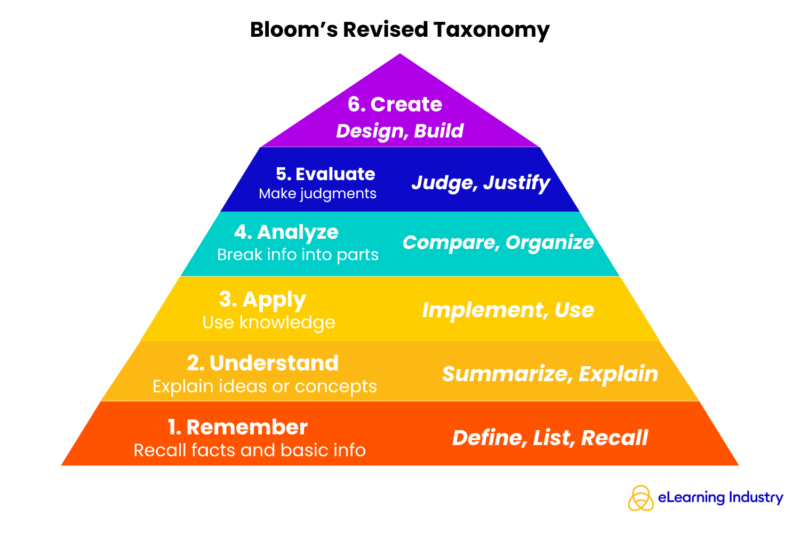
Bloom’s Revised Taxonomy consists of six ranges, typically visualized as a triangle or pyramid, transferring from easy to advanced cognitive processes. These Bloom’s taxonomy ranges, defined beneath, present how learners construct data step-by-step and apply it in real-world conditions.
Degree | Description (Cognitive Degree Which means) | Pattern Verbs (Bloom’s Taxonomy Phrases) | Office Instance |
Keep in mind | Recall fundamental info and data. | outline, listing, recall, establish | Worker remembers compliance guidelines throughout onboarding. |
Perceive | Clarify concepts or ideas in their very own phrases. | describe, summarize, clarify, interpret | Learner summarizes firm coverage in a coaching quiz. |
Apply | Use data in actual conditions. | apply, use, implement, execute | Worker applies a brand new CRM course of in day by day work. |
Analyze | Break info into components and study relationships. | evaluate, differentiate, analyze, manage | The supervisor analyzes efficiency information to establish traits. |
Consider | Make judgments primarily based on standards. | consider, justify, critique, assess | The crew lead evaluates coaching effectiveness after the rollout. |
Create | Produce new or unique work. | design, develop, create, formulate | An Educational Designer creates a brand new onboarding program. |
Utilizing Bloom’s taxonomy cognitive area key phrases (verbs) is necessary as a result of they flip summary studying objectives into clear actions. When utilized accurately, these verbs assist make sure that studying aims match real-world work efficiency. This strategy permits organizations to shift from merely “realizing” to actively “doing,” “pondering,” and “innovating,” thus making studying more practical and performance-focused.
Bloom’s Taxonomy Verbs Defined
The revised Bloom’s taxonomy ranges are sensible instruments for designing studying aims, assessments, and coaching experiences that align with actual office wants. Every degree makes use of particular verbs, which aren’t simply writing instruments however the basis of efficient studying design. The explanation Educational Designers rely closely on Bloom’s revised taxonomy verbs is straightforward: verbs outline what learners really do. Particularly, utilizing the correct verbs helps guarantee alignment between studying aims, actions, and assessments. For instance, “perceive compliance guidelines” is unclear and exhausting to guage, whereas “clarify compliance guidelines in office eventualities” is measurable and actionable. Beneath is an easy breakdown of the 6 ranges of Bloom’s taxonomy and their verbs, with actual examples related to company L&D.
1. Keep in mind
On the base of the Bloom’s taxonomy pyramid is the “Keep in mind” degree. This focuses on fundamental recall of data. It’s the place to begin of all studying. At this stage, learners will not be anticipated to interpret or analyze, however solely to acknowledge or reproduce info.
Frequent Bloom’s taxonomy key phrases right here embrace: outline, recall, listing, establish, and identify.
L&D Instance
A compliance coaching module might ask staff to listing the corporate’s information safety guidelines or outline key coverage phrases. This ensures foundational data is in place earlier than deeper studying occurs.
2. Perceive
The “Perceive” degree focuses on making which means from info. Learners transfer past memorization and start to clarify concepts in their very own phrases. This degree is important for studying switch as a result of it exhibits whether or not learners actually grasp the idea reasonably than simply remembering it.
Key verbs embrace: clarify, summarize, interpret, and describe.
L&D Instance
After studying a coverage, staff could also be requested to summarize its goal or clarify why information privateness is necessary in day by day operations.
3. Apply
At this degree, learners use data in actual conditions. That is the place idea turns into motion. This is among the most necessary phases in company coaching as a result of it displays job efficiency.
Frequent verbs: use, implement, execute, display.
L&D Instance
A gross sales coaching program would possibly ask staff to use a negotiation approach throughout a simulated consumer dialog or an actual buyer interplay.
4. Analyze
The “Analyze” degree is the place learners start to assume critically. They break info into components and study relationships. This degree helps stronger decision-making and problem-solving.
Key phrases embrace: differentiate, evaluate, manage, and study.
L&D Instance
Managers could also be requested to check two efficiency studies and establish patterns that designate variations in crew productiveness.
5. Consider
At this stage, learners make judgments primarily based on standards. It’s a key step in management improvement and strategic pondering.
Frequent verbs: decide, critique, justify, assess.
L&D Instance
A crew chief would possibly consider two challenge proposals and justify which one higher aligns with enterprise objectives and useful resource constraints.
6. Create
On the prime of the revised Bloom’s taxonomy ranges is “Create,” which focuses on innovation and unique pondering. This degree represents the very best type of cognitive engagement.
Key verbs embrace: design, construct, formulate, and develop.
L&D Instance
An Educational Designer could also be requested to design a brand new onboarding program that improves worker engagement and reduces time-to-productivity.
How To Use Bloom’s Taxonomy For Writing Studying Goals
Bloom’s revised taxonomy is a useful software for Educational Designers and L&D professionals. It permits them to translate studying wants into clear, measurable outcomes. As a substitute of writing imprecise objectives, this strategy helps you manage studying aims by cognitive degree. This ensures that every goal displays a particular kind of pondering and efficiency.
At its core, the taxonomy connects on to enterprise outcomes. Every degree of Bloom’s taxonomy, from Keep in mind to Create, helps a special depth of talent. Once you align studying aims with these ranges, you progress from “what learners ought to know” to “what learners ought to be capable of do in actual office conditions.” That is particularly necessary in company coaching, the place affect issues greater than content material protection.
A typical problem in lots of applications is the usage of imprecise language akin to “perceive,” “know,” or “concentrate on.” These don’t replicate measurable outcomes. Nonetheless, through the use of Bloom’s taxonomy verbs, you can also make aims extra exact and actionable.
For instance:
- Weak goal: “Perceive compliance.”
- Sturdy goal: “Analyze compliance dangers in actual eventualities.”
The weak model sits at a low, unclear cognitive degree and is tough to evaluate. The sturdy model makes use of the Analyze degree of Bloom’s revised taxonomy, making it measurable and instantly linked to office efficiency.
One other instance:
- Weak: “Know use the CRM system.”
- Sturdy: “Apply CRM options to handle buyer interactions successfully.”
This shift is what makes revised Bloom’s taxonomy so highly effective for Educational Design. It offers readability, removes confusion, and ensures every studying goal targets a particular degree of pondering.
Total, when writing aims, L&D professionals ought to at all times ask: What degree of Bloom’s taxonomy does this belong to, and the way will I measure it? This straightforward query modifications studying design. It strikes from basic content material supply to structured, outcome-focused studying, aligning with totally different ranges of understanding and academic rules.
Bloom’s Taxonomy In Company Studying Technique
In company studying technique, Bloom’s revised taxonomy is a sensible information that helps organizations design studying that really improves efficiency. For decision-makers in L&D, HR, and expertise improvement, it offers a structured strategy to transfer staff from fundamental data acquisition to higher-order pondering and real-world utility.
Upskilling Applications
When implementing Bloom’s taxonomy ranges to company studying, it turns into particularly helpful for upskilling applications. Many organizations efficiently ship coaching on the decrease ranges, akin to Keep in mind and Perceive, the place staff recall info or clarify ideas. Nonetheless, fashionable workplaces require greater than that. By deliberately designing studying experiences aligned with Bloom’s taxonomy of cognitive ranges, organizations can guarantee staff will not be simply knowledgeable but in addition able to making use of, analyzing, and creating options in real-world eventualities.
Management Growth
In management improvement, Bloom’s taxonomy helps learners transfer from theoretical consciousness to strategic pondering. For instance, early-stage leaders might begin by understanding insurance policies and frameworks, however superior improvement ought to push them to guage advanced choices and create modern methods. Utilizing Bloom’s taxonomy verbs in studying aims ensures that management applications are measurable and guided by motion, reasonably than summary or passive.
Digital Studying
Inside digital studying ecosystems, Bloom’s taxonomy helps construction content material throughout platforms and codecs. Microlearning modules, simulations, and assessments can every goal totally different ranges of Bloom’s taxonomy, making certain a balanced studying journey. A well-designed ecosystem avoids overloading learners with content material that solely targets recall and as an alternative builds functionality progressively.
Bloom’s Taxonomy Chart, Grid, And Visible Fashions
Bloom’s Revised Taxonomy is usually simpler to grasp when it’s proven visually. That’s the reason many Educational Designers depend on instruments akin to Bloom’s taxonomy charts, grids, or the well-known taxonomy triangle (Bloom’s pyramid). These visible fashions assist translate summary studying idea into one thing sensible for course design and evaluation planning.
Bloom’s Pyramid
The Bloom’s pyramid, additionally generally known as the Bloom’s ranges of taxonomy visible, represents the six cognitive ranges in a transparent hierarchy. On the base are lower-order pondering abilities, akin to Keep in mind and Perceive, whereas the highest of the pyramid focuses on higher-order pondering, akin to Consider and Create. This helps L&D professionals shortly see how studying ought to progress from fundamental data to superior pondering abilities. In lots of fashionable Bloom’s taxonomy pictures, the pyramid is up to date with motion verbs to replicate the revised Bloom’s taxonomy, making it extra aligned with actual studying outcomes.
Bloom’s Taxonomy Triangle
One other frequent mannequin is the taxonomy triangle. This mannequin exhibits the identical construction however focuses on how individuals progress and transfer between ranges reasonably than merely following a strict order. It is typically utilized in visible storytelling or to clarify Bloom’s taxonomy to individuals who aren’t lecturers. It emphasizes that learners achieve in complexity over time reasonably than staying at one degree.
Bloom’s Taxonomy Grid
The Bloom’s taxonomy grid is sensible and generally utilized in tutorial design. It helps join totally different ranges of pondering with studying actions or assessments. This alignment permits designers to match Bloom’s taxonomy aims with measurable outcomes and ensures a stability of pondering abilities in coaching content material. Many organizations additionally create their very own templates or charts primarily based on this grid for creating programs.
Bloom’s Revised Taxonomy Vs. Authentic: Key Variations
Bloom’s Revised Taxonomy (typically referred to as revised Bloom’s taxonomy or up to date Bloom’s taxonomy) builds on the unique framework developed by Benjamin Bloom. Whereas each fashions are broadly utilized in training and company studying, they differ in terminology, construction, and utility in fashionable Educational Design.
Nouns Vs. Verbs
The unique Bloom’s Taxonomy (1956) used noun-based classes akin to Information, Comprehension, Software, Evaluation, Synthesis, and Analysis. In distinction, Bloom’s revised taxonomy, launched in 2001, shifts to verb-based classes: Keep in mind, Perceive, Apply, Analyze, Consider, and Create. This transformation displays a stronger deal with motion and measurable studying outcomes.
Construction
When it comes to construction, the unique mannequin is usually represented as a strict hierarchical pyramid by which learners should grasp decrease ranges earlier than progressing to greater ones. That is nonetheless generally used to visualise each fashions. Nonetheless, the revised model is extra versatile and dynamic. It acknowledges that studying just isn’t at all times linear and that learners might function throughout a number of cognitive ranges concurrently.
Outcomes
The actionable outcomes are particularly necessary for Educational Designers and L&D professionals. The revised mannequin makes it simpler to put in writing studying aims utilizing action-oriented verbs. These verbs assist outline measurable outcomes, akin to “analyze buyer information” or “create a coaching plan,” as an alternative of imprecise statements like “perceive information.”
Verdict: Which One Is Higher?
The up to date model improves evaluation design, efficiency monitoring, and talent alignment. It fits at present’s workplaces, the place staff want to use, consider, and create data reasonably than simply bear in mind it. Each fashions are primarily based on the identical concepts, however their variations are clear. The revised mannequin shifts from organizing data in a set strategy to specializing in studying via motion. This makes it extra helpful for at present’s wants in Educational Design and expertise improvement.
Conclusion
Bloom’s Revised Taxonomy nonetheless issues as a result of it’s a sensible pondering software for designing significant studying experiences. It helps Educational Designers and educators transfer past content material supply and deal with how individuals really be taught and apply data. In company studying, it helps higher studying design by aligning aims with actual abilities reasonably than simply idea. It additionally helps organizations measure studying affect extra clearly and constantly. Most significantly, it drives efficiency by making certain coaching results in motion, problem-solving, and actual office outcomes, reasonably than stopping at data recall or passive understanding.
Regularly Requested Questions (FAQ) About Bloom’s Revised Taxonomy
Bloom’s revised taxonomy is a framework utilized in training and Educational Design to categorise studying aims into cognitive ranges. It helps educators construction studying from fundamental data recall to higher-order pondering abilities like evaluation, analysis, and creation.
It was revised to higher replicate how studying really occurs. The unique mannequin targeted on nouns (data classes), whereas the revised model focuses on verbs (energetic pondering). This makes it extra sensible for writing studying aims and designing assessments.
It was revised by a gaggle of cognitive psychologists, led by Lorin Anderson, a former scholar of Bloom, and David R. Krathwohl, one in every of Bloom’s companions.
The revised Bloom’s taxonomy consists of six cognitive ranges: Keep in mind, Perceive, Apply, Analyze, Consider, and Create. These ranges symbolize a development from fundamental recall of data to superior inventive pondering and problem-solving.
- Keep in mind – Recall info (e.g., listing key phrases)
- Perceive – Clarify concepts (e.g., summarize an idea)
- Apply – Use data (e.g., implement a course of)
- Analyze – Break down info (e.g., evaluate information units)
- Consider – Justify choices (e.g., critique a way)
- Create – Produce new work (e.g., design an answer)
Bloom’s taxonomy is a framework for describing totally different ranges of pondering in studying. It begins from remembering fundamental info and strikes as much as creating new concepts or options.
Bloom’s taxonomy is a studying framework that organizes pondering abilities into ranges. It was initially developed in 1956 by Benjamin Bloom and later revised in 2001 by Anderson and Krathwohl to make it extra action-oriented and sensible for contemporary training and coaching design.


